November 25, 2025How a Hotel’s Leisure Pool Area Increases ADR by 15–30%Hospitality pools & Wellness
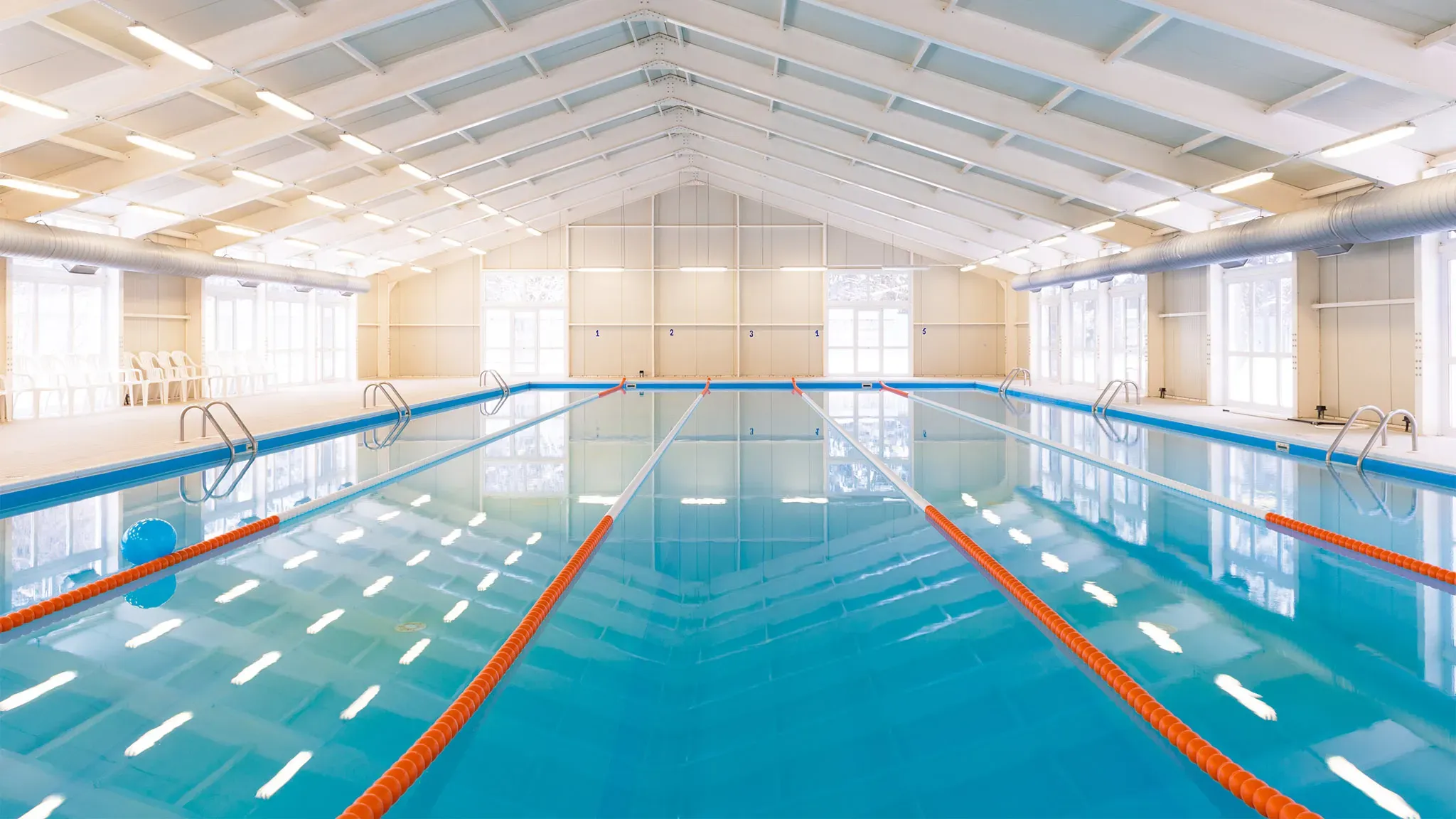
A sports pool is a facility governed down to the geometry of the tank, its depth, water temperature, and lighting by international aquatic sports federations. Unlike recreational pools, there's almost no room for interpretation here: any deviation from the regulations means losing eligibility to host certified competitions at a given level. Here's a breakdown of the requirements that apply to the two baseline tank formats — 25×16 m and 50×25 m — what needs to be built into the hall and the stands, and which of three operating formats such a pool can take.
The 25×16 m format is a short-course pool — the minimum configuration for an eight-lane competition pool.
Length. Under World Aquatics (formerly FINA) regulations, the nominal length is 25.000 m with a tolerance of +0.010/–0.000 m when automatic timing equipment is used (touch panels at both ends). The UK's Sport England Swimming Pools Design Guidance Note allows a comparable tolerance of +0.03/–0.00 m for non-competition-class facilities.
Width and lanes. The minimum width for an eight-lane pool is 16.4 m: 8 lanes at 2.0 m each, plus at least 0.2 m of clear space alongside the first and last lane. A more comfortable "national short course" option is 8 lanes at 2.5 m plus 0.5 m of clearance on each side (21 m total), but the 16 m version is the minimum standard permitted for certified competition starts.
Depth. The baseline regulatory requirement (Facilities Rules) is: where starting blocks are used, at least 1.35 m in the zone from 1 to 6 m from the starting wall, and at least 1.0 m across the rest of the tank. But this is only the minimum threshold for a training or minimum-standard facility. The current World Aquatics Swimming Pool Certification standard (in force since January 1, 2024) requires a minimum depth of 2.0 m, preferably 2.5 m, for World Championship events on a 25 m tank. A separate depth requirement applies to warm-up pools at championships — a minimum of 1.8 m across the entire tank.
Water temperature. For competitive use, 25–28°C — noticeably cooler than in wellness or therapeutic pools, where water is kept warmer for comfort during non-athletic swimming.
Finishing and walls. A deck-level gutter overflow system is required on both long sides, along with a contrasting tile edge at the waterline and raised end walls (0.3 m above water level) fitted with handrails for turns.
Lighting and acoustics. The baseline lighting level for general training use is a minimum of 300 lux (Sport England); for broadcast competitions, requirements are substantially higher and are set separately for each event by the host federation and broadcaster. Above roughly 2 m in height, walls and ceilings require sound-absorbing finishes — without them, reverberation in a hall with a large water surface makes the space unsuitable for extended occupancy by staff and spectators.
The 50×25 m format is the full-size (long course) Olympic pool, subject to the strictest set of rules.
Length. Nominal length is 50.000 m, with a tolerance of +0.010/–0.000 m — precision here bears directly on whether world records can be ratified.
Width and lanes. Standard tank width is 25 m, matching 10 lanes at 2.5 m with no additional technical clearance (lanes run directly to the walls). For the Olympic Games, a minimum of 8 lanes at 2.50 m is required; permanent pools hosting World Championships require 10 lanes, of which 8 are 2.50 m and the outer two (lanes 0 and 9) are 2.40 m with an additional 0.10 m clearance at the wall. In temporary competition pools, all 10 lanes must be 2.50 m with 0.50 m of clearance at the edges.
Depth. The minimum permitted standard (Facilities Rules) is 1.35 m in the starting zone (1 to 6 m from the wall) and 1.0 m across the rest of the tank — this threshold applies only to training and minimum-certified facilities. For the Olympic Games and World Championships, World Aquatics Swimming Pool Certification sets a minimum depth of 2.5 m across the entire tank. In practice, most modern Olympic-class venues are designed with a depth of 2.5–3.0 m — the greater water volume dampens turbulence from strokes and starting-block action, which directly affects swim speed and record ratification.
Water temperature. The same 25–28°C range as for the short-course pool — the regulations make no distinction based on tank length.
Infrastructure around the tank. A full-size pool of this class is typically fitted with a separate warm-up/training pool, which by regulation must operate independently of the main tank in terms of water treatment and temperature, so training isn't interrupted while competition is underway in the main pool.
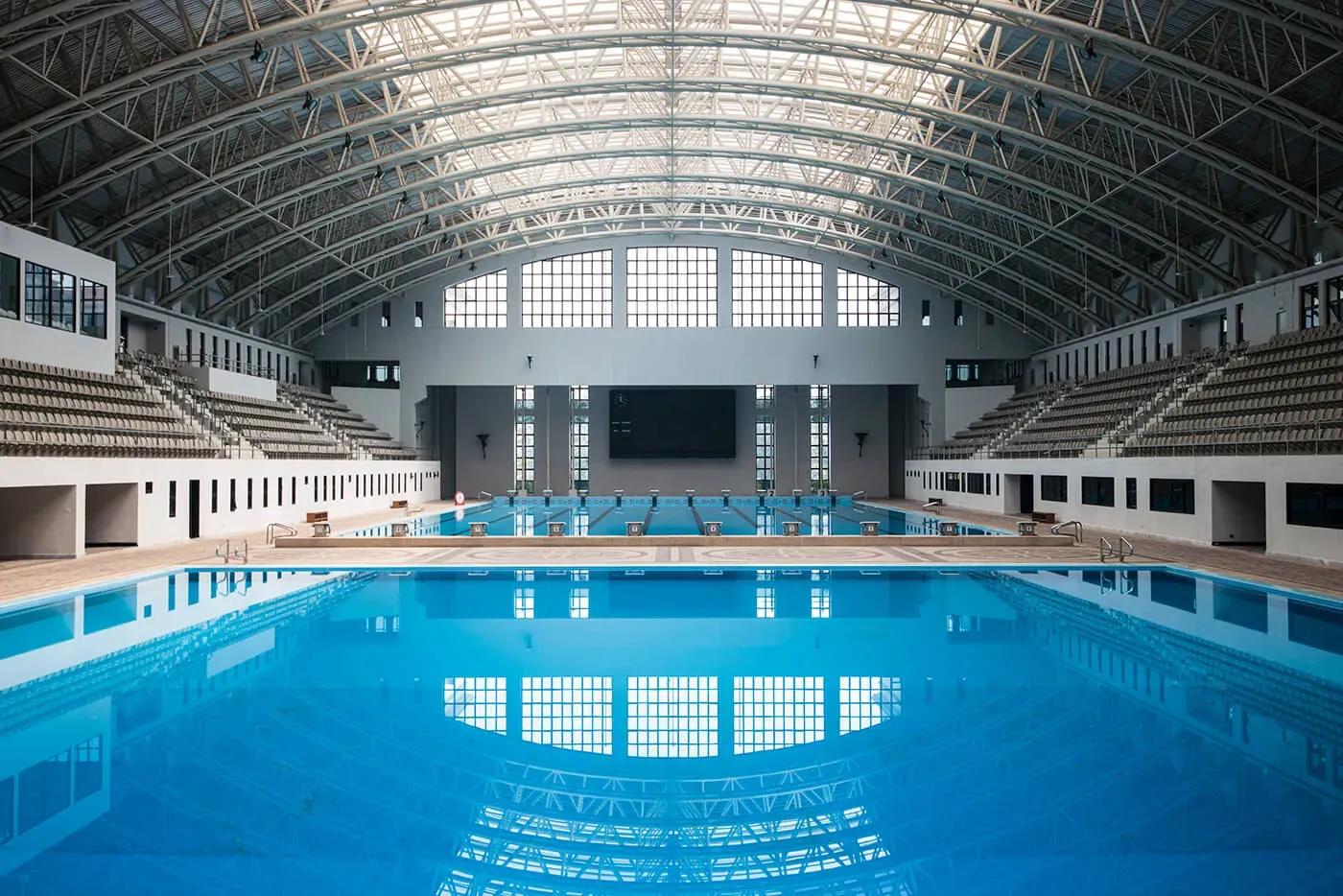
The depth requirement isn't a single number — it's a function of two variables: the competition status the facility intends to host, and the aquatic discipline the tank is designed for. Below are only the values fixed in current World Aquatics regulations:
| Tank purpose / level | Minimum depth | Standard tier |
| Swimming without starting blocks (training use) | 1.0 m | Minimum Standard Pools |
| Swimming with starting blocks, zone 1–6 m from the wall | 1.35 m | Minimum Standard Pools |
| Warm-up pool at championships | 1.8 m across the entire pool | not tiered in the source — a general Facilities Rules requirement |
| Swimming, 25 m pool, World Aquatics World Championships | 2.0 m (preferably 2.5 m) | Olympic Standard Pools |
| Swimming, 50 m pool, Olympic Games and World Championships | 2.5 m across the entire pool | Olympic Standard Pools |
| Multi-sport use on one pool (swimming + artistic swimming) at OG/WC | 3.0 m | Olympic Standard Pools |
| Water polo (field of play) | 1.8 m | general Facilities Rules requirement |
| Artistic (synchronized) swimming at OG/WC, including warm-up pools | 3.0 m | Olympic Standard Pools |
| Diving | 5.0 m (updated standard) | general minimum under the 2025 Competition Regulations |
Note: the regulations divide requirements into three tiers — Olympic Standard Pools (mandatory for the Olympic Games and World Championships, except Masters), General Standard Pools (other federation-sanctioned tournaments, with possible allowances for existing facilities), and Minimum Standard Pools (the threshold for all other federation-sanctioned competitions). For some parameters (warm-up pools, water polo, the current diving depth standard), the governing documents don't specify an explicit tier — the depth is set as a single requirement regardless of competition level.
| Parameter | 25×16 m | 50×25 m |
| Nominal length | 25.000 m (+0.010/–0.000) | 50.000 m (+0.010/–0.000) |
| Minimum width / lanes | 2.0 m | 2.5 m |
| Depth (minimum/training standard) | ≥1.35 m at the start / ≥1.0 m across the rest of the pool | ≥1.35 m at the start / ≥1.0 m across the rest of the pool |
| Depth for World Championships / Olympic Games | ≥2.0 m (preferably 2.5 m) | ≥2.5 m across the entire pool |
| Water temperature | 25–28°C | 25–28°C |
| Separate warm-up pool | not required | required for WC/OG-level competitions |
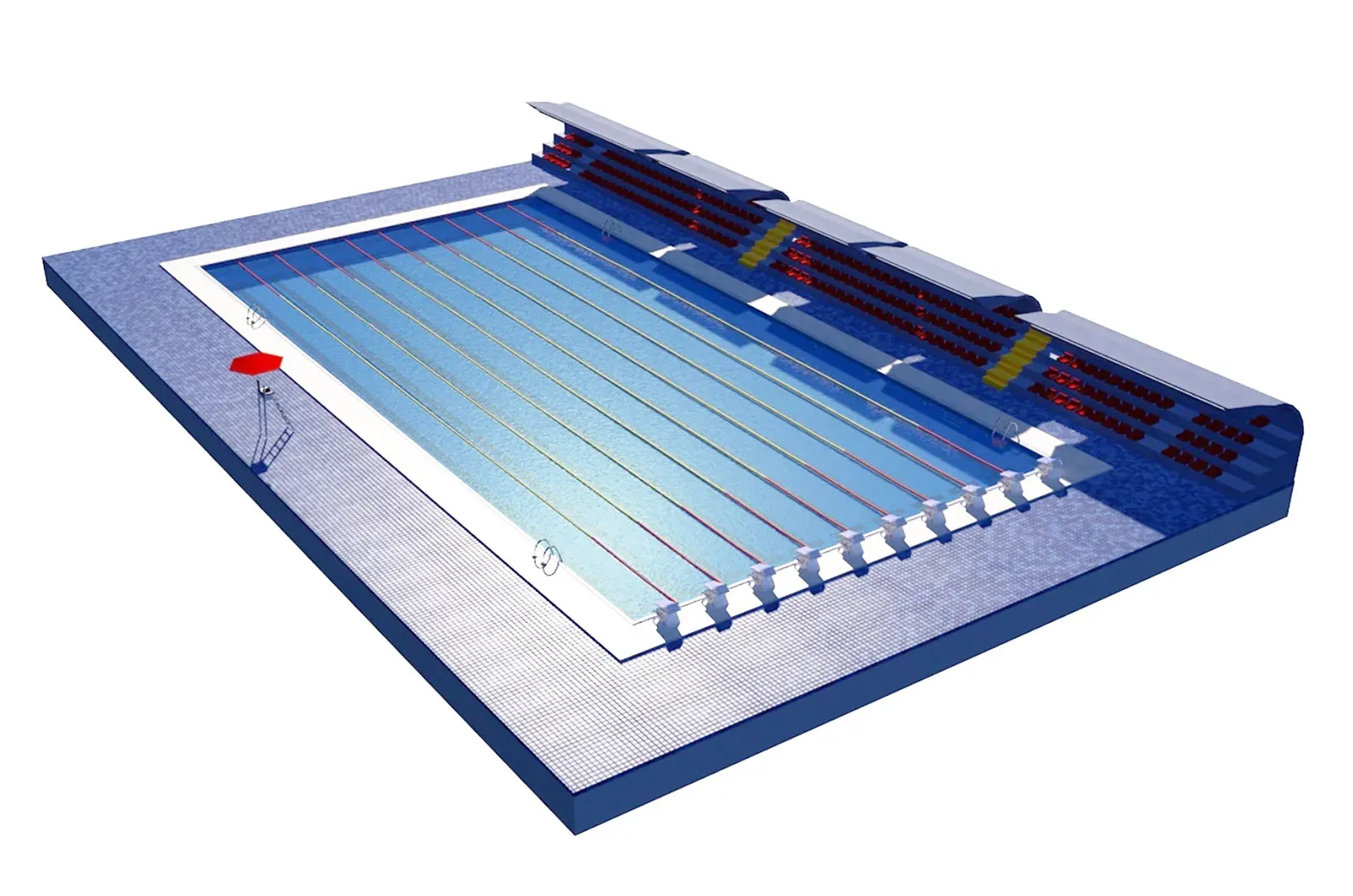
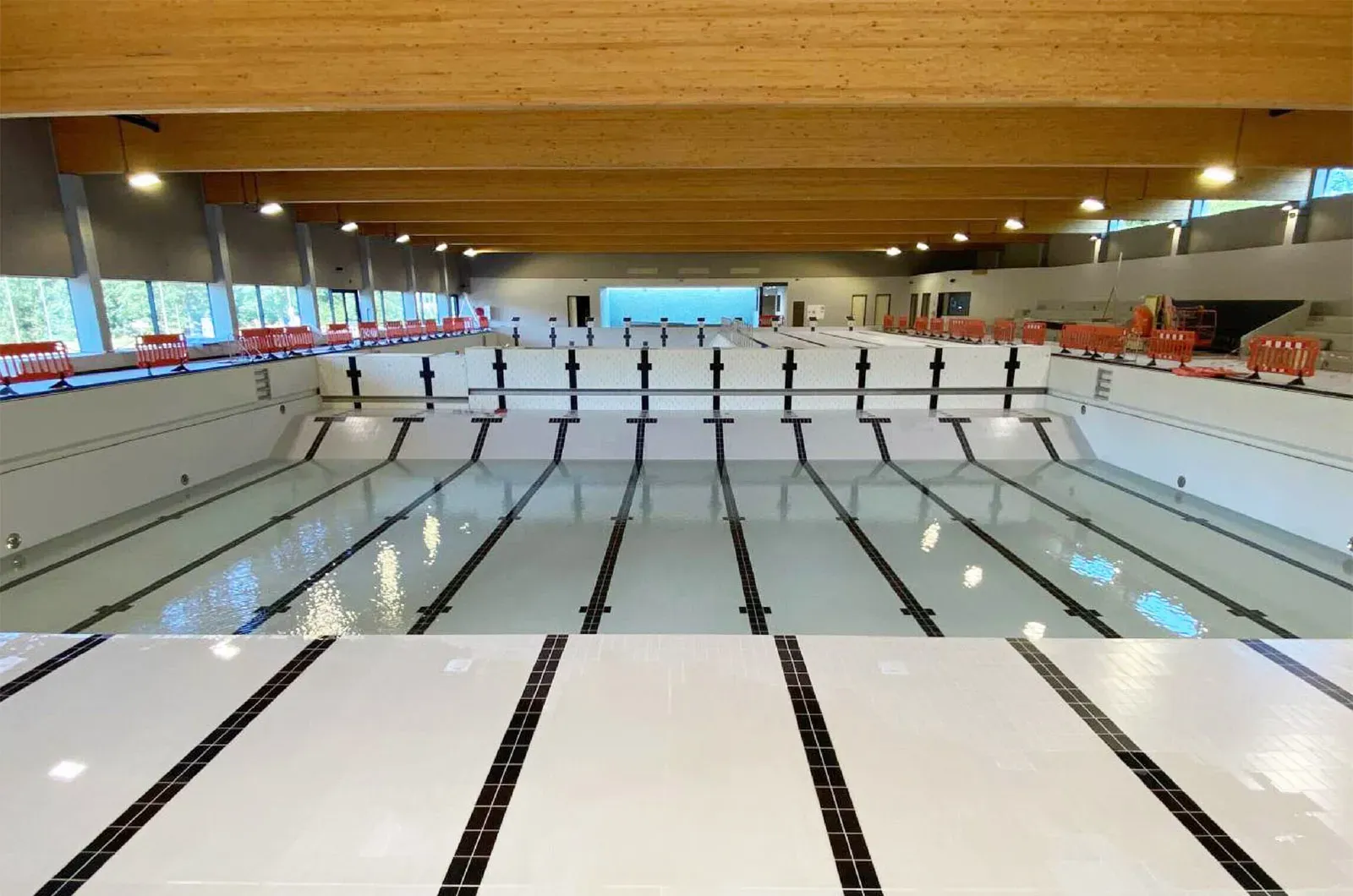
Stand capacity isn't a fixed figure — it's tied to the competition status a facility intends to host, and it's directly linked to World Aquatics classification: Olympic Standard Pools (for the Olympic Games and World Championships, except Masters), General Standard Pools (for other federation-sanctioned tournaments), and Minimum Standard Pools (for all other competitions under the regulations).
In practice, industry design guidance ties stand capacity to event level as follows:
For design purposes, this means: if a facility is built with headroom for a future rise in competition status, the stand structure and the hall's building systems (ventilation, emergency exits, press and doping-control zones) need to account for that escalation from the outset — adding stands to a facility already in operation is significantly harder, both technically and financially, than reserving space for it at the construction stage.
Format 1. Standalone Complex for Professional Training and Competition
A freestanding facility: a full-size pool (usually 50×25 m), a separate warm-up pool, spectator stands, officiating and timing infrastructure, doping-control and press zones, a medical block, and permanent premises for sports federations and clubs.
Visitor composition and behavior: the core audience is national and club-level athletes, coaching staff, and officials; on competition days, an episodic, peak-driven spectator flow; the rest of the time, a steady but narrow flow of organized training groups on federation schedules.
Advantages: the highest possible technical status — the right to host certified competitions up to international level; long-term contracts with federations and clubs deliver predictable utilization of training hours; significant reputational and image value for the host city or region.
Disadvantages: the highest capital and operating load per square meter — a large hall volume, stand engineering, and certification requirements that must be renewed regularly; outside training and competition windows, the facility sees low utilization, since it isn't designed for a mass, non-specialist visitor flow.
Operating specifics: a rigid scheduling grid with booking priority for federations and national teams; a dedicated staff — starters, timekeepers, personnel servicing the stands and electronic officiating systems; the need for regular recertification of the pool and equipment against World Aquatics regulations when preparing to host a given tier of tournament.
A pool (most often 25 m, frequently in the 25×16 m configuration with a limited number of lanes) as part of a larger fitness facility, without competition infrastructure or stands — or with only minimal folding seating for children's lessons.
Visitor composition and behavior: the audience is fitness club members; attendance is frequent and habitual but less intensive per individual visit; different user groups coexist on the same water at the same time — lap swimmers, group aqua-aerobics classes, and children's lessons.
Advantages: the pool functions as a retention and acquisition tool for the fitness club's membership base rather than as a standalone business unit; engineering requirements are lighter than for a competition facility — World Aquatics tolerances on length and timing don't need to be met; water treatment and other technical systems can be integrated with the fitness center's shared engineering.
Disadvantages: limited lane depth and width make this kind of pool unsuitable for serious team training, let alone official competition starts; there's an inherent conflict of interest between user groups sharing the same water — lap swimmers need cooler water (25–28°C) and clear lane separation, while aqua-aerobics groups and families with children are more comfortable in warmer water — reconciling both regimes in a single pool without disadvantaging one group is difficult.
Operating specifics: the schedule is built around a grid of group classes and "open" lap-swimming windows; minimal dedicated staffing — typically one instructor/lifeguard per shift; reception, changing rooms, and part of the building systems are shared with the rest of the fitness facility, which lowers the per-unit cost of operation.
A structurally separate zone within a larger water facility, fitted with a movable floor and/or a movable divider (bulkhead) that allows the pool configuration to change — from a full-size competition lane setup to a shallower, reduced volume for swim lessons or warm-up.
Visitor composition and behavior: on competition or club training days, the zone operates as a closed facility with an organized, targeted flow of athletes and spectators; at other hours, the same zone can open for general use — swim lessons, lap swimming for complex visitors. The defining feature of this format is that the same physical volume of water serves fundamentally different usage scenarios at different times.
Advantages: maximum flexibility in using the same hall footprint — the facility can earn revenue simultaneously from federation/club rentals and from serving the complex's general visitor flow, without duplicating infrastructure; a movable floor allows depth to be adapted for children's lessons without setting aside a separate pool for it.
Disadvantages: movable-floor and bulkhead systems are capital-intensive, mechanically complex equipment requiring a dedicated service contract and carrying downtime risk if something breaks; switching configurations takes operational time and can't be done instantly between sessions; when the zone shares a water treatment loop with the main water body, it's difficult to simultaneously maintain the stricter, cooler water regime required for competitive swimming.
Operating specifics: a separate, independent water treatment loop is required for the reconfigurable zone if it needs to periodically meet competition-grade parameters under DIN 19643 (a different load category, and a different temperature and disinfection regime than the rest of the facility); trained technical staff are needed specifically to service the movable-floor/bulkhead mechanics; the schedule must fix closed (competition) and open (general-use) windows in advance, since reconfiguring on the fly within a single day is limited.
Pool geometry, depth, water temperature, and length tolerances are set by World Aquatics regulations and cannot be "relaxed" without the facility losing its eligibility to host certified competitions — these parameters need to be fixed at the concept stage. The 25×16 m format is the minimum permitted configuration for an eight-lane competition pool; the 50×25 m format additionally requires a separate warm-up pool if the facility aims to host World Championship- or Olympic-level events. Stand capacity needs to be planned around the target competition status, not current demand — adding stands after the fact is significantly harder, both technically and economically, than reserving the space at the design stage. The choice of operating format — a standalone sports complex, a pool within a fitness center, or a transformable zone within a larger water facility — determines not just the engineering scope but the operating logic, staffing structure, and nature of the visitor flow, and needs to be fixed before design begins, rather than adapted to a pool that's already been built.
Sources