Rafting & Lazy rivers
Lazy rivers for waterparks and resorts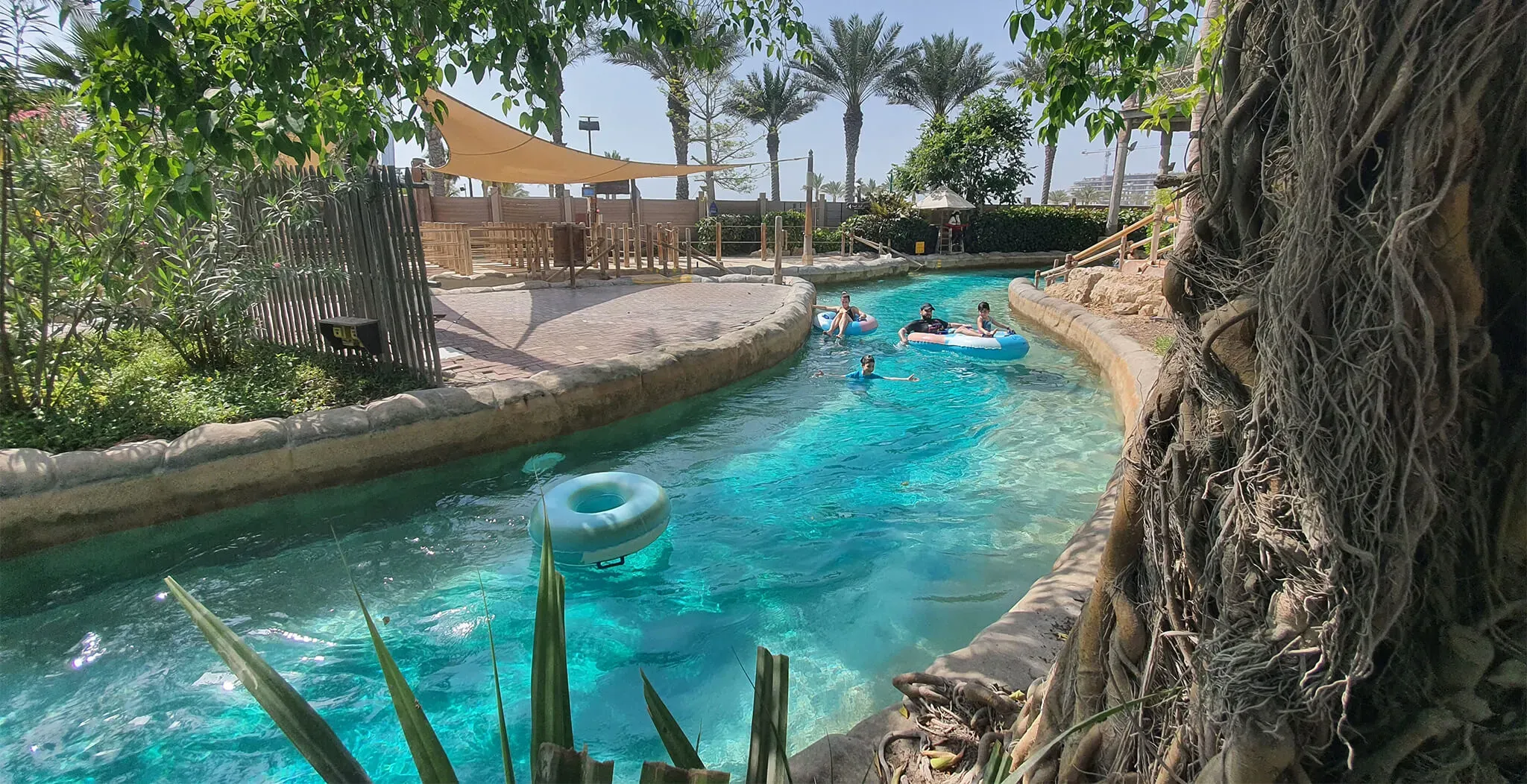
A river that transforms the entire amusement park into a single continuous attraction
Design and Construction of Rafting Rivers and Lazy Rivers for Waterparks, Hotels and Resorts
We design and build artificial rivers for waterparks and resorts, creating a controlled water flow along a closed-loop channel. The process begins with site analysis, identifying key guest circulation points, and defining flow scenarios — relaxing slow current, wave dynamics, accelerated sections, or hybrid configurations.
At the concept stage, the river alignment is developed: length, width, depth, entry and exit points, turning zones, islands, locations for pump stations, and water treatment systems. Once the layout is approved, our engineers carry out hydraulic and structural calculations and prepare the construction documentation.
The construction phase includes building a concrete basin or modular river channel, applying waterproofing, installing infrastructure, and laying utility networks. Once equipment is installed, flow parameters are calibrated. Depending on the concept, additional effects—waves, whirlpools, or rafting sections—may be integrated.
An artificial river delivers measurable economic value to the property: it extends guest stay time, reduces queue pressure on main attractions, distributes visitors across the site, increases average spend, and boosts overall capacity without the need for additional ride construction.
Equipment manufacturing for the river is carried out at our European production facility in full compliance with the project specifications. Strict quality standards are maintained, and systems are assembled using industrial-grade components from leading global manufacturers, including Siemens, ABB, and General Electric.
Lazy River and Rafting River Types
Lazy River
Description & technical features: Lazy River is a classic closed-loop waterway with a constant-bottom profile and slow directional flow. The channel width typically ranges from 3–4 m, with track lengths starting from 80 m, making it suitable for small hospitality pools up to large-scale waterparks and resort complexes.
Hydraulics & control: Flow is generated by continuous recirculation, with controllable velocity around 0.4–0.6 m/s, adjustable depending on operating needs. Pumping systems operate with inverter-based control to enhance energy efficiency, extend equipment life, and optimize consumption.
Wave River
Structure & operating principle: Wave River is an enhanced Lazy River with integrated wave generators positioned approximately every 60–70 m along the course. These units create waves up to 1.2 m high, transforming the river from a passive relax zone into an engaging active attraction.
Wave generation technology: The wave system operates on a pneumatic principle using air compressors to form wave patterns. Operators may adjust frequency, wave form, and intervals. Recommended operation is cyclic (15–30 minutes per hour) to balance guest experience and energy efficiency.
Torrent River
Design and Dynamics: torrent River is an enhanced version of the classic Lazy River, incorporating a sequence of wave stations positioned approximately every 40–50 meters along the route. These generators produce pulse waves up to 1.5 meters high every 2–3 minutes, dramatically increasing the emotional experience of the ride. The system can operate continuously; however, a cyclic operating mode is recommended to balance guest experience and operating costs.
Technology and Control: hydraulic wave generators are used to produce strong wave impulses, while turbines support a sustained fast current throughout the channel. The control panel allows operators to adjust flow velocity, wave configuration, and automated operation schedules based on predefined calendars.
Rapid River
Rapid River represents a new generation of river attractions, designed to offer a heightened emotional experience along a familiar route. Structurally, it is a shallow water channel with a depth of 20–40 cm and a variable bottom profile. Alternating levels create unique hydrodynamic effects – from slight acceleration to active turbulence – giving guests a constantly changing experience throughout the entire course. The minimum recommended length is 200 meters, making it suitable for large waterparks and a valuable upgrade to existing Lazy River layouts.
The river is driven by submersible pumps that generate directional flow along a closed-loop system. To optimize energy consumption and enhance guest engagement, interval operation — approximately 30 minutes per hour — is recommended instead of continuous running. The control cabinet allows speed adjustments and selection of automated modes. User-friendly software supports timers, schedules, and automatic start sequences, ensuring safe and intuitive operation.
Speedy River
Speedy River is a dynamic enhancement to the traditional Lazy River, designed to amplify the ride experience and guest entertainment value. It consists of short channel sections, typically 20–30 meters long, engineered to create intensified flow and visual bubble effects, simulating increased velocity and a more energetic passage.
The enhanced flow is achieved using centrifugal pumps that deliver powerful currents and can be configured for 24/7 operation.
Speedy River is an excellent solution for waterparks, hotels, and leisure complexes seeking to boost adventure elements within a river zone and offer a more active alternative to classic Lazy River segments.
Project Timeline for a Waterpark River
Start of Works
5 weeks
10 weeks
15 weeks
20 weeks
Concept and Project Documentation3 – 4 weeks
step 1This stage includes developing the alignment of the river channel, defining its geometric parameters (width, depth, total length), and determining guest entry and exit points, hydraulic nodes, and supporting engineering infrastructure. Based on the selected operating scenario, hydraulic and structural calculations are performed, and the required flow velocity, pump capacity, and automation requirements are established.
The result of this phase is a complete project package including plans, diagrams, and equipment specifications, ensuring accurate construction execution and stable operational performance.
Civil Works8 – 10 weeks
step 2During the civil works phase, the primary structural elements of the river are constructed. The basin or channel is formed according to design elevations with the required geometric profile. Technical rooms are built in parallel for the installation of pumping, filtration, and control equipment. Engineering utilities are installed and embedded components and sleeves are placed in accordance with the project plan.
Manufacturing, Assembly and Logistics8–9 weeks
step 3The equipment package is configured for each specific project and includes filtration and recirculation systems, high-pressure pumps and turbines, wave-generation modules, pipeline fittings, and automation and control components. All equipment is prepared for on-site installation and undergoes quality and performance verification prior to shipment to the customer.
Equipment Installation, Commissioning and Testing4 – 6 weeks
step 4At this stage, turbines, pumps, filtration systems, wave modules, and automation components are installed in their designated locations. Recirculation pipelines, power cabling, and control systems are connected. Once installation is complete, commissioning is carried out, including tuning flow parameters and configuring automated operating modes. The phase concludes with safety verification and system testing under normal and peak load conditions.
Timelines may vary depending on project complexity and location.Water Engineering Co provides full project oversight throughout every stage of implementation, ensuring that construction aligns with the approved concept and design documentation.
Author supervision monitors construction quality and compliance with design solutions, while technical supervision follows the installation of equipment, engineering connections, and system commissioning.
This level of support minimizes risks, reduces rework costs, and guarantees correct and reliable performance of the artificial river during operation.