Spray parks and Water play zones
Spray parks / Interactive splash play zones turnkey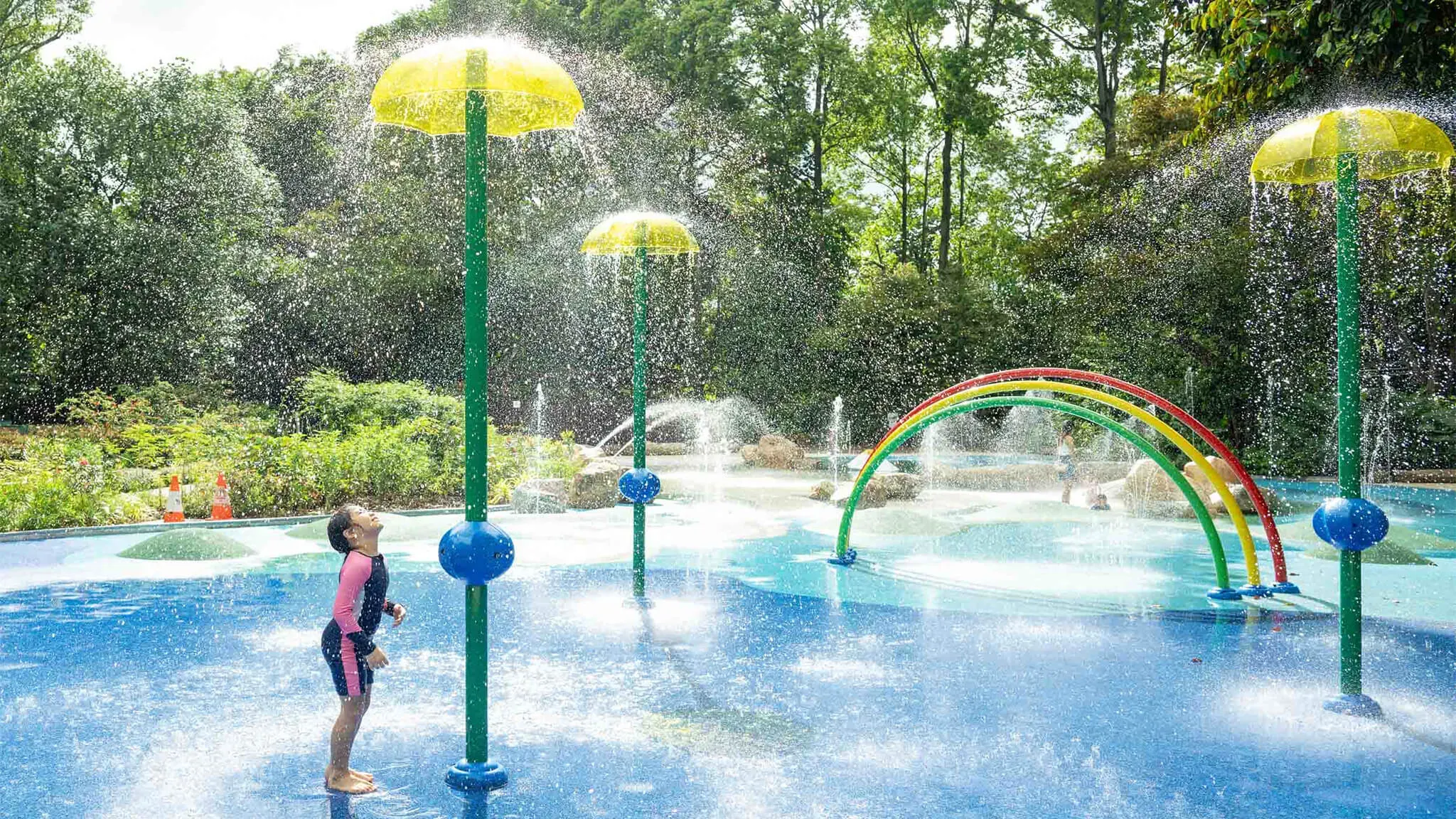
We create spaces that function as true destinations: safe for toddlers, exciting for children, and valuable for businesses
Concept and Master Plan of a Spray Park
We design spray parks as safe, inclusive, and energy-efficient water play environments integrated into amusement parks, municipal parks, retail centers, hotels, and resorts. The process begins with a contextual analysis: site location, pedestrian flows, utility access, operational seasonality, client requirements, and commercial models.
During the concept phase, we develop:
- the usage scenario: family zone, children’s play area, active play, or a mixed configuration;
- a functional layout with age- and activity-based zoning;
- preliminary selection of water play features and interaction types: ground sprays, arches, misting elements, tipping buckets, and water cannons;
- visual theme and design direction: nature, urban, geometric, character-based;
- integration with landscaping and amenities: shade structures, seating, dry rest areas, cafés and supporting services;
- preliminary cost estimate and operational model.
Spray Park and Water Play Area Engineering
The design stage includes a full engineering scope in compliance with sanitary, construction, and operational requirements.
Engineering scope includes:
- hydraulic design for water supply and recirculation systems;
- water treatment scheme selection: recirculating filtration and disinfection or a drain-away system;
- routing of pipelines and cable systems;
- specification and sizing of filtration, disinfection, and automation equipment;
- architectural and civil solutions: concrete structures, drainage, embedded parts, surge tanks, non-slip surfacing;
- control and automation schemes: zone activation, water-saving modes, flow limitations, timers, sensor activation and interactive triggers;
- accessibility and safety requirements: zero-depth water interaction, no drowning risk, barrier-free access, and solutions for reduced-mobility users.
Construction of Spray Parks and Water Play Areas
Once the design is approved, we deliver the full construction and technical cycle on a turnkey basis.
Key implementation stages include:
- site preparation and utilities installation;
- construction of the foundation, drainage system, and surface slopes;
- installation of pipelines, embedded parts, and equipment support structures;
- installation of play features, pump and filtration systems, and control cabinets;
- connection of automation systems and programming of operating modes;
- hydraulic and load testing;
- system start-up, pressure tuning, water flow adjustment, and zone calibration;
- training of operating staff and preparation for seasonal shutdown and maintenance.
After commissioning, we provide warranty and service support, as well as opportunities for future upgrades: additional play features, expanded capabilities, and updated interaction scenarios.
A spray park is an asset that delivers value from day one: it enhances the attractiveness of a destination, increases visitor flow, extends dwell time, and strengthens the social impact of the site.
Social and Financial impact
A modern spray park creates a measurable social and financial return within the very first season of operation.
- For municipal and public parks, visitor traffic during the summer typically increases by 20–40%, and family dwell time extends by 30–60 minutes, stimulating surrounding small business activity.
- Within amusement parks or aquatic zones, daily attendance can grow by 15–25%, and when combined with F&B offerings, food and beverage revenue increases by 10–20%.
- In hotels and resorts, the presence of an interactive water play area can increase family bookings to 30–50% of demand in peak season and raise ADR by 5–15% through product differentiation.
- For retail and entertainment centers, a spray zone can extend average visitor stay by 15–35%, directly boosting the turnover of tenants and operators.
Capital and operating costs are significantly lower than those of traditional pools (30–50% CAPEX savings with recirculation systems), while zero-depth design and simplified operation reduce staffing needs and safety risks — turning the spray park into a long-lasting, predictable, and socially meaningful asset.
Project Timeline for a Spray Park
Start of Works
3 weeks
6 weeks
9 weeks
12 weeks
Concept and Design Development2 – 3 weeks
step 1At this stage, we develop the conceptual and engineering design for the future spray park. The work begins with an analysis of the site, surrounding infrastructure, and technical conditions. We then form a functional layout for the area: age-based zoning, selection of interactive water features, usage scenarios, and integration with landscaping and amenities. Once the concept is approved, full engineering design follows: hydraulic calculations, water treatment and drainage schemes, foundation and surface design, pipeline routing, automation, and safety requirements.
The result is a fully visualized concept and a complete engineering package.
General Construction Works4 – 6 weeks
step 2At this stage, we prepare the site and build the engineering infrastructure for the future spray park. The scope includes earthworks, construction of a reinforced concrete foundation with slopes and a drainage system, installation of pipelines and cable routes, and mounting of embedded parts for spray nozzles and equipment supports.
Once these preparatory works are completed, the site is fully ready for installation of play features, pump and filtration systems, and connection of control and automation networks.
Production and Equipment Logistics4–5 weeks
step 3At this stage, all components of the future spray park are manufactured and assembled. The manufacturer produces interactive water play features, ground spray nozzles, columns, arches, and specialty water structures, and also assembles pump groups, filtration systems, and automation cabinets.
All equipment undergoes factory quality control, performance testing, and protective material treatment. Once the set is complete, it is packaged and delivered to the site — including water play elements, technical systems, and installation components.
Installation and Test Commissioning3 – 4 weeks
step 4At this stage, all spray park components are installed and connected to the engineering systems. The scope includes installation of water play features, pump and filtration equipment, control and automation cabinets, as well as final assembly of pipelines and cable networks.
Once installation is complete, hydraulic testing and operational verification are carried out: pressure adjustment, spray pattern calibration, zone activation testing, and fine-tuning of control and safety systems.
The stage concludes with a trial start-up and confirmation that all systems operate correctly prior to handover and commissioning.
Timelines may vary depending on project complexity and location.Sequential execution of each stage is a critical condition for the successful delivery of a spray park.
The concept and design phase establishes the foundation of the future facility and defines the engineering parameters required for accurate construction.
General construction works ensure proper site preparation and correct integration of utilities, which is essential for the subsequent installation of equipment.